According to the person in charge of the company, due to the long-term influence of heat generated by heating machines and equipment in the production workshop, the workshop is extremely hot and humid. Therefore, we searched for another environmental air conditioning installation company online and installed two environmental air conditioners to provide overall ventilation and cooling for the workshop through duct air supply. However, after the installation of the environmentally friendly air conditioner was completed, it was found that the cooling effect of the environmentally friendly air conditioner was not very obvious. Despite multiple feedbacks to their after-sales personnel, they did not find out where the problem was.
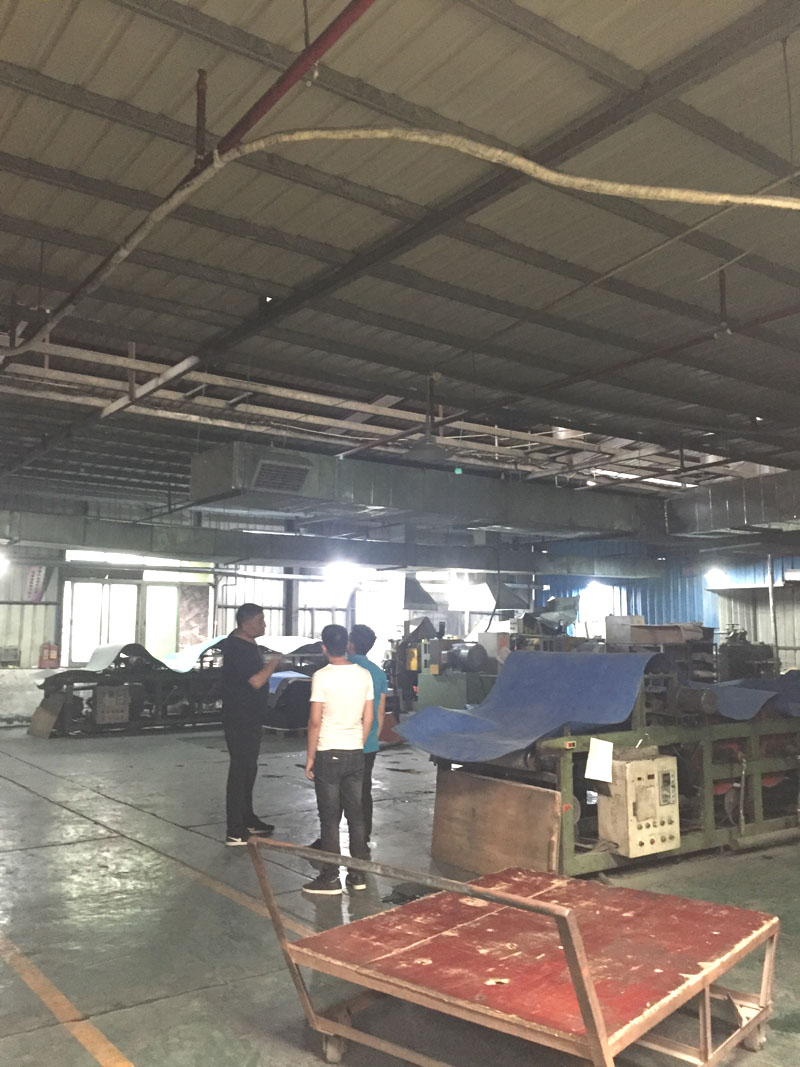
Until later, I learned from a friend that our Guangdong company specializes in providing ventilation and cooling solutions for factory buildings, so I invited our technical personnel to come and see what was going on! After careful investigation by our technical personnel, it was found that there were significant issues with the design of the air duct. Due to inadequate air duct design, the cooling effect of the environmentally friendly air conditioner was not good.
In fact, the specific cooling effect is closely related to the design scheme of installing environmentally friendly air conditioning. When designing a factory for cooling, it is necessary to understand how to calculate the ventilation rate in the workshop, the cross-sectional area of the air duct, and the wind speed of each air outlet, or whether the workshop is suitable for cooling the position or the overall cooling. When designing air ducts, it is best to apply formulas to design the wind speed of each air outlet and the cross-sectional area of the duct. Here, the editor will explain in detail the calculation method of pipeline section area and air exchange rate with professional knowledge.
Calculation method for pipeline section area: For example, to design an air duct with a wind speed of 12m/s and a maximum air volume of 18000 cubic meters per hour for environmentally friendly air conditioning, the following formula can be used to calculate: 1. (Total air volume of 18000m ³/h) ÷ (3600/s)=(Total air volume of the air duct of 5m ³/s); 2. (Total air volume of the duct 5m ³/s) ÷ (wind speed 12m/s)=(pipe section area 0.41 square meters); 3. Wind speed calculation method: (total air volume of air duct 5m ³/s) ÷ (pipe section area 0.41 square meters)=(wind speed 12m/s.)
Reference for air exchange rate in various occasions: 1. Definition of air exchange rate: Air exchange rate (times/hour)=total indoor air supply volume (m ³/h) ÷ {indoor area ㎡) × indoor height (m); 2. General environmental requirements for air exchange rate are 25-30 times/hour; 3. In densely populated public places, a ventilation rate of 30-40 times per hour is required; 4. Places or production workshops with dense crowds and high temperatures require a ventilation volume of 40-50 times per hour; 5. High temperature and severely polluted production workshops require a ventilation volume of 50-60 times per hour; 6. In humid southern regions, the frequency of air exchange should be appropriately increased, while in hotter northern regions, the frequency of air exchange can be appropriately reduced.
So, the cooling effect of environmentally friendly air conditioning is closely related to the design of the air ducts and the number of air changes. If the air duct design is not done well, it will directly affect the cooling effect of environmentally friendly air conditioning. In fact, the principle of designing environmentally friendly air conditioning ducts is similar to the relationship between water pressure and water pipes. Large and small pipes determine the flow rate of water, while the cross-sectional area and air exchange rate of environmentally friendly air conditioning ducts also determine the cooling effect of environmentally friendly air conditioning.